The portfolioFive gamesThree kinds of knowing

The games

Every mechanic in these games was chosen to mask an educational load. The adolescents who co-designed them told us plainly what they would tolerate — fast, competitive, social, physical — and the nutrition content had to fit inside those constraints rather than the other way around.

Design constraints

Four rules the games had to obey

Straight out of the co-creation workshops. Not preferences — each one got violated at some point in development, and each violation cost a session.

  1. Fast, or not at allJenga beat every other commercial game in the cohort vote, 18 to 10. Speed and physical consequence outranked strategy in every group. Sessions were built to run 15–30 minutes.
  2. Simple enough to explain in a sentence"The rules were a bit confusing" was the single most common piece of playtest feedback. The prototype that ignored this — the food environment game — was the only one sent back for a rewrite.
  3. Social, never solitaryThe one activity that failed outright during the intervention was a solitary writing task. The same nutritional rule, rebuilt as a trading game, worked immediately.
  4. Every role gets an actionPlaytesters were blunt about holding a role that gave them nothing to do. Passive positions were designed out.

The content

Six food groups, one plate rule

All five games run on the same underlying content: the six food groups of the Ethiopian Food-Based Dietary Guidelines, and the rule that anchors them.

Key message 1

Eat from at least 4 food groups at every meal, and 6 different food groups every day. A plate may hold four or five items, but if they come from the same group they count once.

GROUP 1Grains, roots & tubersInjera, dabo, kocho, kolo, genfo
GROUP 2Pulses & legumesShiro wot, misir wot, bakela, shimbra, ater
GROUP 3Nuts & oilseedsGroundnuts, selit, suf, telba, nug
GROUP 4Animal-source foodsDoro wot, tibs, asa, enkulal, wetet, ergo, ayib
GROUP 5Vegetables & fruitsGomen, timatim, karot, muz, birtukan, avocado
GROUP 6Fats & oilsVegetable oils, nug oil, kibe

Alongside these sit the limiting messages — keep added sugar under 30 g a day, salt under 5 g — and the two lifestyle messages the games treat as bonuses: eight to ten glasses of water, and thirty minutes of physical activity.

Game 01

Beyaynetu

Named for the shared platter of many small dishes. Three levels, played in sequence as students' competence grew — the loudest game in the set, and the highest-energy.
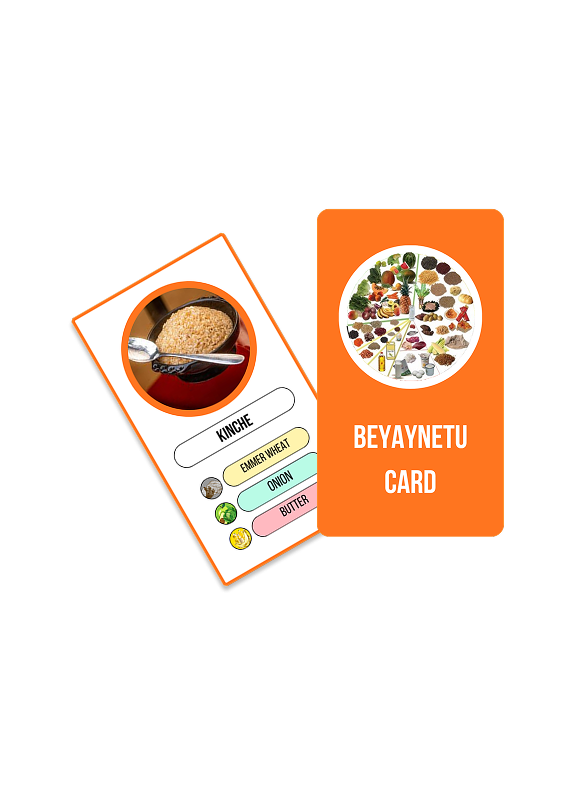
Beyaynetu game cards
Beyaynetu Level 1 in a school session. Recognition under time pressure, not deliberation.
  • Teaches declarative knowledge — identifying foods and classifying them into the correct nutritional group.
  • Mechanic fast, competitive pattern matching.
  • Level 1 sort at speed. Call a group number, players race to grab a matching card.
  • Level 2 build a meal. First player holding four cards from four different groups wins the round.
  • Level 3 trade for the day. Target is six groups, and players may trade with each other — out loud, so the table can object.

The blind-cohort test recorded a specific gain: a marked improvement in identifying grains and white roots, the group students were least sure about at baseline.
Design decisionLevel 3 exists because a worksheet failed
Observed

Mid-intervention at School 1, the team tried a meal-planning writing challenge — write down three days of meals, scored against the diversity rules. The session's energy crashed.

Evidence

The cognitive load was too high and it stripped out the competitive edge. It felt like schoolwork, which is precisely what the project exists to avoid.

Design decision

Rebuild the identical lesson as Beyaynetu Level 3 — familiar cards, low cognitive load, social negotiation on top. It revived groups that were experiencing fatigue.

Game 02

Gursha

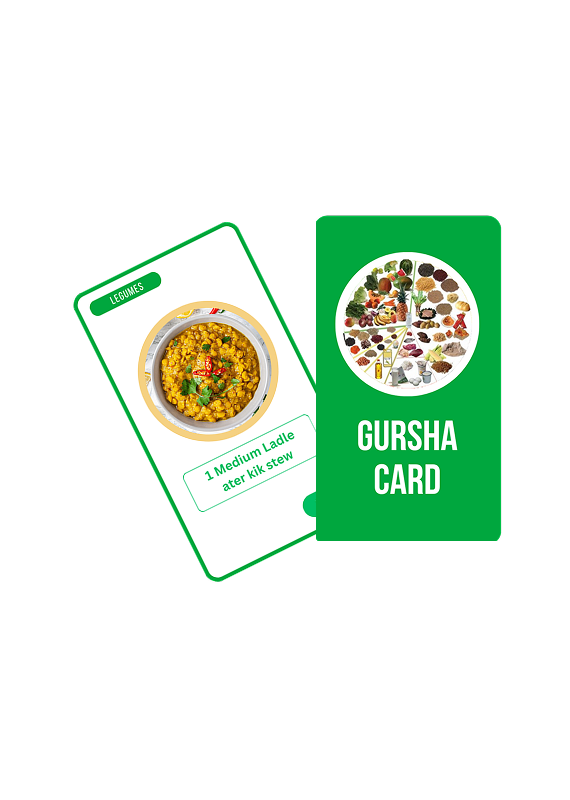
The game that carries the project's name, and the only one built around a physical act. Slower and more deliberate than Beyaynetu — it depends entirely on players talking to each other.

  • Teaches procedural knowledge — portion control and dietary balance.
  • Mechanic strategic resource management against proper dietary proportions.
  • The gursha players hand food cards to each other. A card you were handed must be played next turn, and cannot be handed back.
  • The narrative the bell has rung, lunch is short, and the team has to assemble one balanced meal before time runs out.

The passing rule is why the game exists. Co-designers kept asking for a physical, social action — and handing food to someone is what the word means. It forces the team to negotiate rather than each player optimising alone.

Blind testers said the rules felt confusing for the first few minutes and became intuitive the moment play started — and reported high replay value, saying repeat plays would teach them more.

Gursha game cards
Gursha in play. The narrative wrapper was added after testing, to give the portion lesson somewhere real to land.
Known weakness

Gursha degrades when a group is unstable. When absences forced unfamiliar students together, gameplay quality dropped — hardest for this game, because it needs strong team communication to work at all.

Game 03

Digis

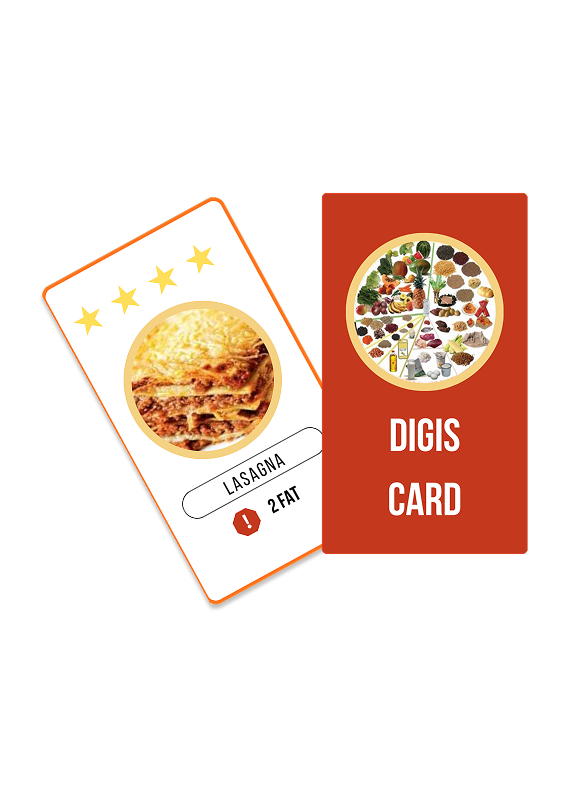
The most ambitious game in the portfolio and the hardest to get right. It moves attention outward — from what you eat to where it came from, and what that costs you.

Digis game cards
Digis. Danger cards and event cards land between rounds, which is where the emotion comes from.
  • Teaches systems knowledge — food origins, sourcing, and the food environment.
  • Mechanic spatial navigation linking food items to places of production and sale.
  • The risk layer danger cards and event cards after each round. Cheaper, more convenient locations carry more of them.

This game drew the strongest emotions of the intervention. Real frustration at losing points to event cards — which the team read as high motivation, not a problem.

It also gave the clearest single proof of learning. At School 2, players began avoiding street-food locations to dodge penalties — meaning the underlying logic had been internalised.

Design historyThe one that was sent back
Observed

In blind testing, Digis ran too long and confused players on both concept and scoring. Testers said they would need a much clearer explanation of how to play and how to win.

Evidence

Despite the confusion the educational message still landed — students could identify where to access healthier versus unhealthier food.

Design decision

Keep the concept, cut the complexity. Rules, scoring and playtime were all simplified before rollout, and round counts were capped.

Print & play

Make your own set

A printable pack of food cards, reference sheets and rules summaries — enough to run all three games with a class, a club or a family, using an A4 printer and a pair of scissors.

What's in the pack

  • 63 food cards across the six FBDG food groups, plus limit and bonus cards. Each card carries a real serving size from the published guidelines.
  • Reference sheets — the six groups, the 11 key messages, and a full serving-size table for settling arguments mid-game.
  • Rules summaries for Beyaynetu Levels 1–3, Gursha and Digis.
  • A printable Digis board — twelve food-environment locations from the home kitchen to the street food stand.
  • A score sheet for up to twenty players.

Printing it

  • A4 at 100% scale. Do not use "fit to page" — the cards will not line up.
  • 160–250 gsm card gives a deck that survives a school term. Plain paper is fine for a first try.
  • Cards are 60 × 85 mm, nine to a sheet, with cutting guides.
  • For double-sided decks, print the card-back sheet on the reverse and flip on the long edge.
Please read before printing

This pack is a teaching set assembled from the mechanics described in the Gursha project report and from the published Ethiopian FBDG booklet. It is not the official Gursha rulebook or card artwork used in the intervention schools — those remain with Efuye Gela and carry the co-creators' names on the back of each rule page. Swap this file for the produced version before distributing under the project's name.